

Cisserusa
In the first century AD, Pliny the Elder records the name of an island in the Natural History, situated in the waters off Cnidus. He calls it Cisserusa. He gives no description of its appearance or size, nor does he mention its inhabitants. The name appears among those of other small Aegean islands, some of which can no longer be identified with certainty. Greek archaeologists have proposed that Cisserusa was the island now known as Gyali, linking the ancient place name to κίσσηρις, the Greek word for pumice.
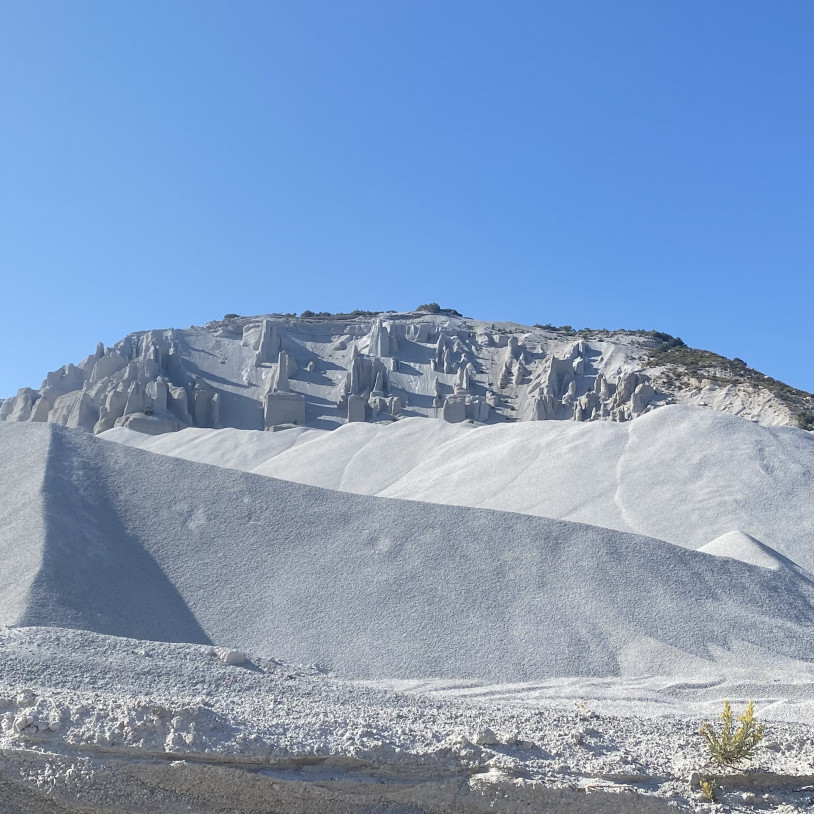
The island consists of two volcanic hills joined by a narrow isthmus. The south-western hill is composed predominantly of white pumice, while the north-eastern one contains perlite and obsidian, a natural volcanic glass formed by the rapid cooling of magma. The modern name, Gyali, also evokes glass in Greek. If the identification with Cisserusa is correct, the island would have been named, at different moments in its history, after two of its own materials: porous stone and volcanic glass.
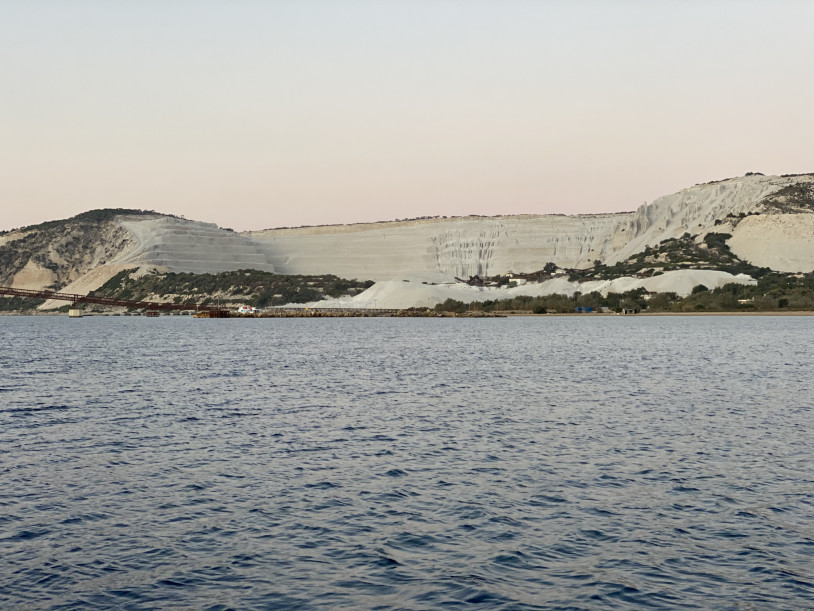
Today, both parts of the island are subject to quarrying. The pumice is used primarily in construction, while perlite has numerous industrial applications. The ancient name survives as a possible geographical identification. The modern one has also become a commercial designation, used to identify the stone shipped from the island.
The House Above the Quarry
Above the stepped terraces of the pumice quarry, the remains of a Neolithic house built more than six thousand years ago are still preserved. It is an elongated structure with gently curving walls, two rooms once covered by pitched roofs, and a spacious courtyard. Its area measures precisely 102.375 square metres. The floor is paved with slabs of schist; traces of burning survive in a small room that archaeologists have identified as a kitchen.
Excavations uncovered pottery vessels and numerous stone tools. The house belonged to a larger settlement occupied during the fourth millennium BC, when Gyali lay along the maritime routes used by boats carrying obsidian across the Aegean. From the hill on which the house stood, it was possible to watch the sea passages towards Nisyros, Kos and the coast of Asia Minor.
The foundations rest directly on the island's soft bedrock. For millennia, the sheltered position, surrounding vegetation and a high stone wall helped protect the remains from accumulations of windblown pumice.
In 2020, a proposal was discussed to relocate the building to another part of the island, near the beach. The plan involved dismantling the structure and reconstructing it in a position considered more accessible and less exposed to erosion. Archaeologists objected, pointing out that the walls had been built from irregular stones without mortar, and that the foundations were unlikely to withstand being detached.
Excavations along the slope had also revealed that the Neolithic settlement extended beyond the house. Parts of it remained unexplored, and removing the building could have allowed the quarry to expand into precisely those areas.
In December 2023, the Association of Greek Archaeologists called for any decision to be postponed until further investigations had been completed. The proposal had been submitted by the Municipality of Nisyros, on the basis of a study undertaken in collaboration with the quarry operator. The archaeologists challenged its rationale: in their view, protecting the building risked becoming the justification for opening up another section of the deposit to extraction.
The house had remained on the same hill for more than six millennia. The proposal to preserve it would have separated it from the ground on which it had been built.
One Hundred Million Tonnes
According to the commercial distributor YALI, Gyali's pumice deposit contains approximately one hundred million tonnes of material, with a reported average annual output of one million tonnes. At this rate, extraction could continue beyond 2100. This projection is based on estimated reserves and a sustained level of production; it is not a prediction of what the island will eventually look like.
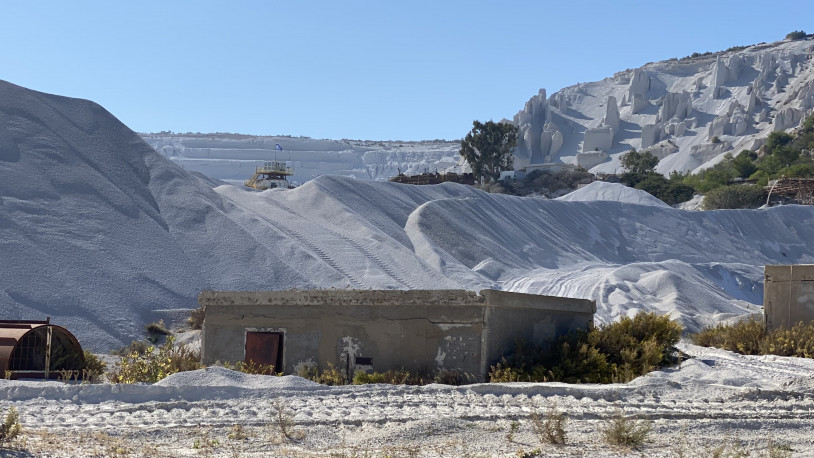
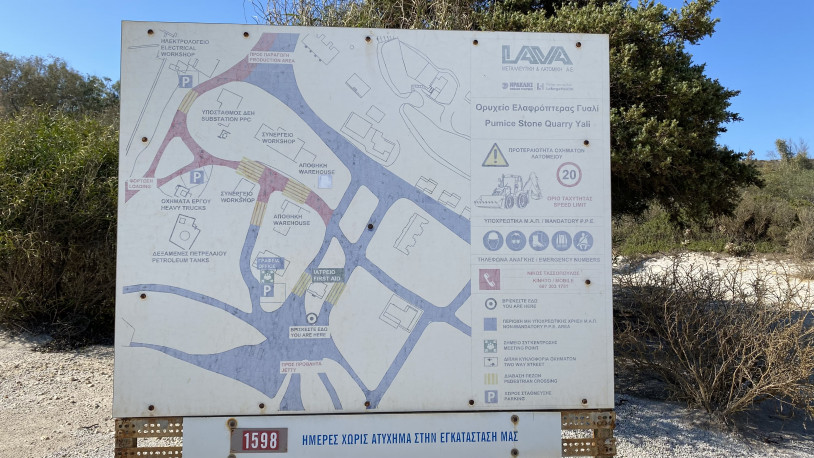
Pumice is removed from the hills, graded according to fragment size and shipped by sea. The estimated reserves make it possible to plan extraction over a period longer than a human lifetime. Yet calculating those reserves reveals nothing of the shape Gyali might take over that time, or how much land will have to be altered to reach deposits that have yet to be worked.
In December 2023, Greek archaeologists warned of the risk of the island's "ecological annihilation". They opposed the expansion of quarrying, the transformation of the hills and the potential disturbance of archaeological areas that had not yet been explored. They also alleged that environmental restoration obligations had not been fulfilled.
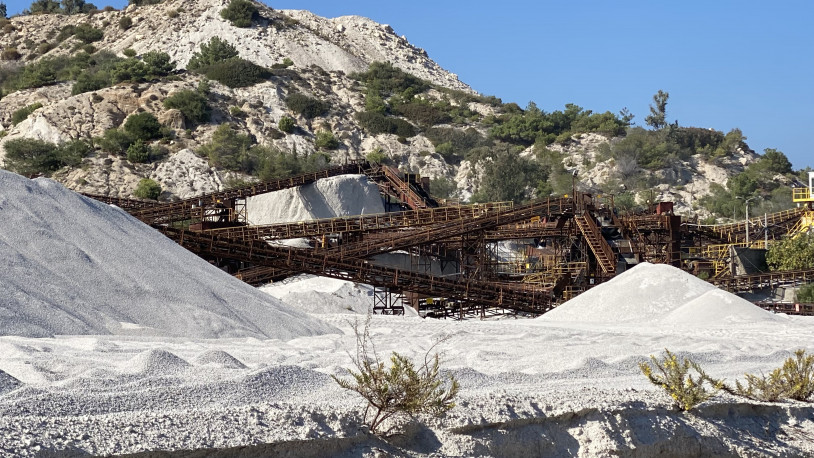
Between the commercial forecasts and the archaeologists' concerns, Gyali continues to be measured in different quantities and spans of time. The deposit may remain productive beyond 2100, but none of the documents consulted makes it possible to reconstruct with any precision what the island will look like by then.
Exposed Roots
Between 1994 and 1999, four botanists surveyed Gyali to study its vegetation. They identified 241 taxa of native plants, 149 of which had never previously been recorded on the island. Much of its surface was covered by woodland dominated by Pinus brutia, a species of pine widespread in the eastern Mediterranean. According to the researchers, this was the only known natural woodland of the species growing on pumice and perlite substrates on such a small island.
Soil depth varied considerably. Over perlite, the soil layer was often less than thirty centimetres deep; over pumice, it could reach or exceed half a metre, thinning again on the steeper slopes. The plants thus grew on volcanic deposits with differing physical properties, in porous ground subject to long periods of summer drought.
Some of the pumice extracted from Gyali is now also used as a growing medium for soilless cultivation. The porous structure of the granules allows them to retain water while maintaining air circulation around the roots of cultivated plants.
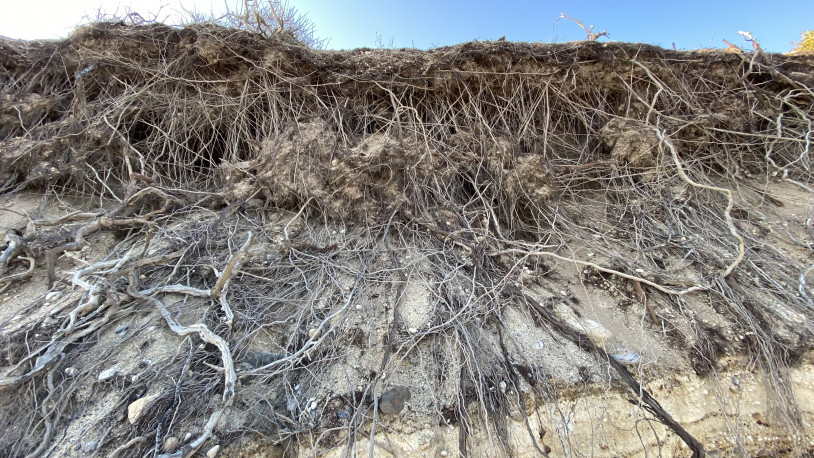
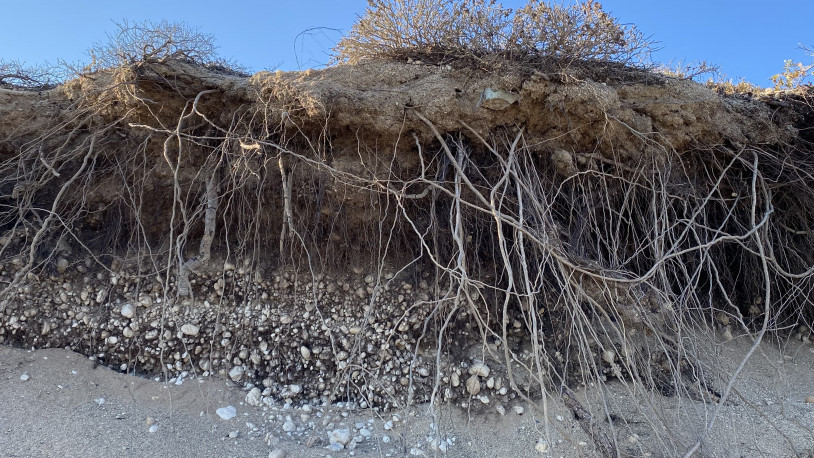
Elsewhere, on a slope of the island, a section of exposed earth reveals a dense tangle of roots. Some are extraordinarily fine, others thicker and twisted; still others disappear into the undisturbed ground. They wind around fragments of stone, descend vertically or spread across the face of the slope. The photograph alone cannot establish what exposed this portion of the subsoil, nor can the plants to which the roots belong be identified with certainty.
Petrified Foam
In the south-western part of Gyali, the quarry cuts through more than a hundred and fifty metres of pumice deposited on the seabed. The layers contain fragments measuring up to a metre and a half across, some traversed by polygonal fractures and marked by surfaces formed during rapid cooling. They originated during ancient submarine eruptions, when gas-rich magma fragmented and cooled, producing masses of volcanic glass riddled with tiny cavities. Currents dispersed some of the material, while other fragments, after remaining suspended in the water, settled on the seabed. Over time, they accumulated in successive layers, forming deposits that movements of the Earth's crust would eventually raise above sea level.
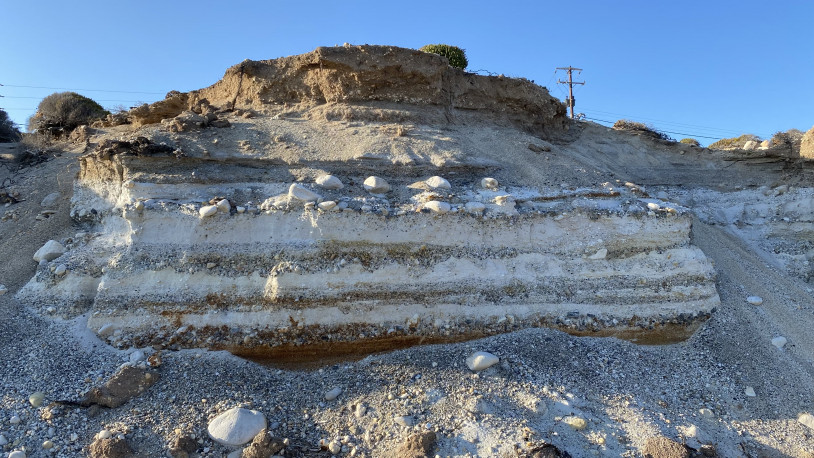
In the fourth century BC, Theophrastus recorded a belief that some stones were born of fire, while others took shape from the foam of the sea. Pumice could be the residue of combustion, but it could also arise from a marine substance that gradually thickened until it acquired the consistency of stone. The philosopher did not rule out either possibility. The variety of stones, their different weights and properties, suggested to him that nature might produce the same substance through different processes. Some pumice stones from Nisyros even seemed unfinished: they crumbled into the finest sand as soon as they were picked up, as though they had been taken from the earth before their formation was complete.
Foam already occupied a singular place in the Greek imagination. Hesiod recounts how Cronus severed the genitals of his father Uranus and cast them into the sea. For a long time, that immortal flesh was carried by the waves, while a white foam rose around it. Within the foam, a maiden grew, eventually reaching first Cythera and then Cyprus, where she emerged from the water as Aphrodite. The goddess had spent time within the foam, gradually taking shape before revealing herself to gods and mortals.
A treatise on the nature of plants, transmitted under Aristotle's name but of uncertain authorship, offers an even more unusual account of marine stone. When waves collided violently, they produced a thick, whitish foam resembling rich milk. As it reached the shore, the sand caught and held its denser substance. Salt and the gradual evaporation of the water did the rest: the grains adhered to one another until what had initially been soft and unstable became stone. The sea could thus generate solid bodies through the very turbulence by which it wore others away.
In the pumice of Gyali, the spaces once occupied by gas remain visible as countless vesicles within the volcanic glass. Some fragments were light enough to float; others sank as water gradually penetrated their pores. The largest retain rapidly chilled margins and internal fractures, which geologists have been able to examine directly in the quarry walls. Rather than a single compact mass, the deposit consists of an immense accumulation of fragments laid down under different conditions and never subsequently cemented together.
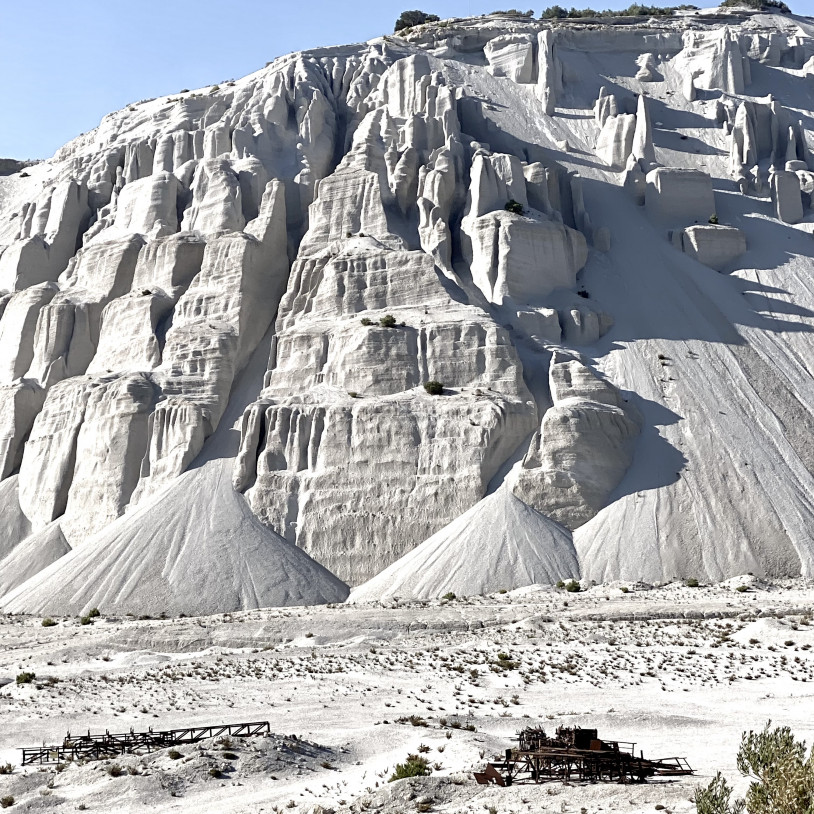
When Rodney Allen and Jocelyn McPhie studied the quarry towards the end of the twentieth century, they encountered a difficulty arising not from the complexity of their measurements but from the material itself. The larger fragments were riddled with fractures and tended to disintegrate when disturbed. It proved impossible to establish their full size distribution: the pieces broke apart during the very operations required to measure them.
The stones of Gyali had long since completed their solidification. Magma had become volcanic glass; the fragments had settled on the seabed and, after an immense interval, had been raised together with the strata that contained them. Yet they had never acquired the cohesion of cemented rock.
In the quarry walls, some of those fragments still retained the shapes they had assumed as they cooled. Once disturbed, they could break along ancient fractures, separating into smaller pieces. To measure them, they had to be removed from their original positions; in removing them, the researchers risked losing the very forms they were trying to understand.
Topology of the Unknown — The Remaining Distance
Gyali, 2146
The first smooth surface appeared on a quarry wall that had not been worked for eleven years. It was a patch of white pumice, just over three metres wide, where the familiar irregularities of the rock had vanished. There were no longer any grains or fractures, or the minute shadows that made the material recognisable even from a distance. Light spread evenly across it, without reflection. It looked as though someone had polished the mountain from within.
Eleni, the geologist assigned to investigate the phenomenon, initially suspected an unusual alteration of the volcanic glass. She had known those walls for nearly twenty years. She could distinguish between the different deposits, recognise the surfaces left by machinery, even identify the fine fractures caused by changes in temperature. But this portion of rock bore no trace of its formation. It was as white as the rest of the quarry, yet seemed to belong to an entirely different substance.
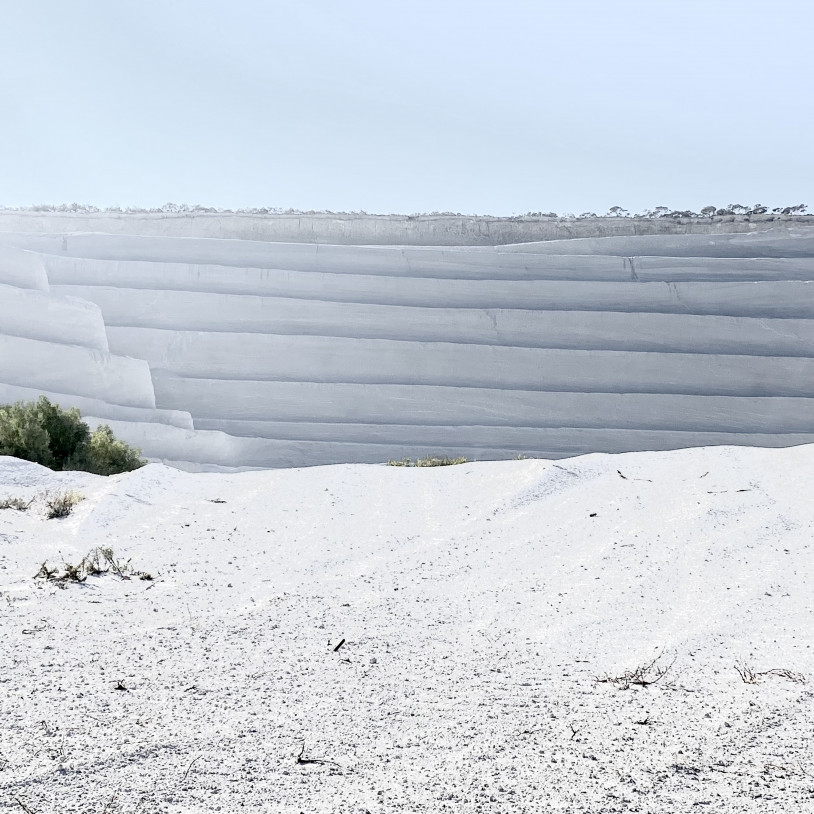
The first attempt to take a sample failed. The drill rotated normally, the motor met no resistance, yet no dust or fragments appeared. The monitor indicated that the bit had penetrated twelve centimetres. When it was withdrawn, there was no hole in the wall. Eleni brought her hand close to the surface without quite touching it. She felt no heat, nor any of the vibrations that a surface so close to the operating machinery should have transmitted.
Over the following days, the wall began to change shape. Its irregularities slowly disappeared, as though being reabsorbed into the rock. The edges of the quarry benches became rounded, the hollows grew shallower, and some terraces eventually merged without leaving any visible boundary between them. There had been no collapses, and the topographical surveys registered no loss of material. The quarry retained the same mass, but it was becoming impossible to tell where one surface ended and another began.
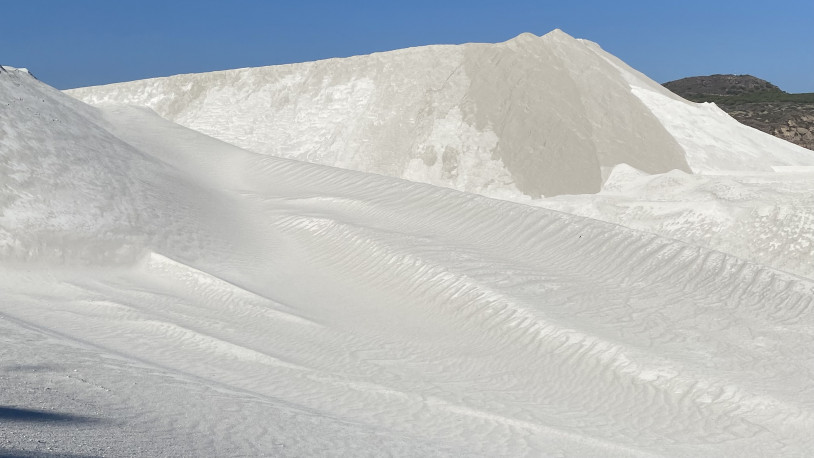
Eleni had arranged for a neutron tomography scanner to be brought to the site. The images revealed that beneath this apparently seamless surface, the pumice still contained millions of cavities. The gases from the ancient eruption had left their imprint intact within the volcanic glass. Internal fractures, some large enough to accommodate a human body, were still present. But none of them reached the outside.
The scans revealed passages, chambers and small interconnected voids. Their courses could be traced through tens of metres of rock, showing where they widened and where they narrowed again. Yet whenever the technicians tried to locate the corresponding openings on the quarry wall, they found nothing but the immaculate white surface.
One afternoon, Eleni tried to press a thin metal plate against it. The sensor registered a distance of four millimetres. As she pushed, the reading fell to two, then one. The plate continued to advance, but it never quite touched the stone. No force was pushing it back. She could simply keep moving it closer, reducing the gap to an ever smaller measurement.
The experiment was repeated with other materials, with identical results. The instruments began registering distances smaller than those they had been designed to measure. The surface remained visible and could be located with absolute precision, yet it could not be reached.
A mathematician at the Kos observatory was the first to suggest that perhaps it was not the stone that had changed. During one of his long conversations with the quarry team, he spoke of a distance that could be divided indefinitely without ever reaching zero. By way of explanation, he recalled Zeno's paradox, in which Achilles can never catch the tortoise because each time he reaches the point where it was, the animal has already moved on.
Eleni pointed out that the tortoise, at least, was still walking.
The mathematician did not answer immediately. Then he asked whether she had ever tried measuring the distance from the other side of the wall.
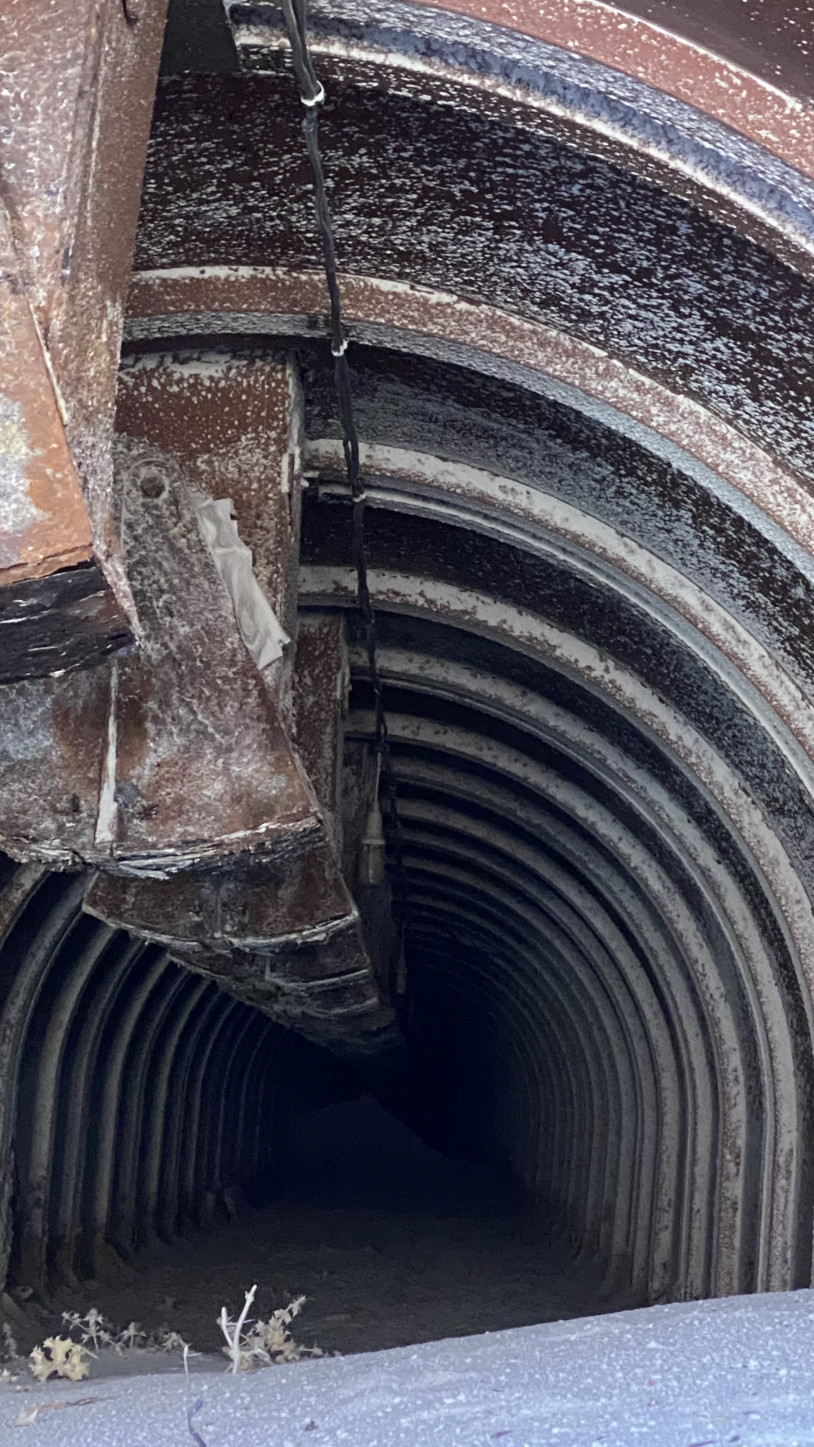
Meanwhile, the phenomenon continued to spread. It crossed the last quarry faces, reached ground that had never been excavated and began altering the old paths. Stones lost their roughness without changing colour. The channels carved by rainwater disappeared, though the rain continued to follow the same gradients. At night, under the quarry lights, the great white surfaces seemed to cast no shadows. They were not luminous. There was simply nothing to interrupt the light.
After several months, the evacuation of the island was ordered.
Eleni stayed behind to complete a few measurements. The phenomenon had reached the isthmus joining the two hills, but the buildings of the research station were still accessible. The laboratory was functioning, and supplies of water and energy were sufficient. The service vessel would return for her the following morning.
During the night, the smooth surface reached the coast.
The vessel arrived shortly after dawn. The sea was calm and visibility was perfect. From aboard, the quarry structures could be clearly seen, along with the now motionless conveyor belts and the vast white deposit covering the south-western slope. Eleni was waiting on the quay, a small suitcase at her feet.
When the captain ordered the vessel to come alongside, it continued moving without getting any closer to shore. The navigation systems showed a distance of less than a metre. Water flowed normally along the hull, the propellers were turning, yet the quay remained exactly where it was.
Two smaller boats were lowered. The first came within a few centimetres of the shore and remained there, its engine running. From the second, the crew tried throwing a rope. Eleni watched it approach and stretched out her hand. The rope swayed just beyond her fingertips. She tried several times to grasp it, until the captain told her to move back.
The end of the rope appeared to be separated from her by an insignificant distance. In the enlarged images, even the individual fibres of the rope could be distinguished, along with tiny salt crystals deposited on the quay. Yet the space between them did not diminish.
Eleni returned to the station while the boats continued searching for somewhere to land.
Over the following days, drones and small autonomous vehicles were dispatched. Some spent hours advancing towards the coast, transmitting images of the surface in ever greater detail. Individual grains of pumice could be seen, tiny insects motionless among the stones, strands of vegetation carried by the wind. Not one of the machines managed to reach the ground.
Radio signals, however, crossed that space without difficulty. Eleni could speak to the researchers, send photographs, receive instructions and continue working. From within, the island retained its familiar distances. She could reach the laboratory, walk to the quarry and climb the old paths. Her own measurements registered none of the anomalies detected by the vessels.
She tried throwing small objects towards the sea. A stone, a tool, an empty container. She watched them move away, but could never determine when they should have reached the water. Beyond a certain point they became difficult to follow, as though the distance continued to increase without their movement slowing down.
Once, she tried tracking a small piece of pumice through binoculars. She saw it suspended beyond the cliff, still close enough for her to make out its shape. She watched until the light changed. The fragment had not fallen.
After that, she stopped throwing things.
The monitoring of Gyali continued for almost a year. Satellites still registered its position, the tides rose and fell along its shores, and the wind continued to carry white dust across the hills. The island remained fully present on every map. It had lost none of its surface area, nor had its coordinates changed. It could be photographed from any distance, provided no one attempted to reach it.
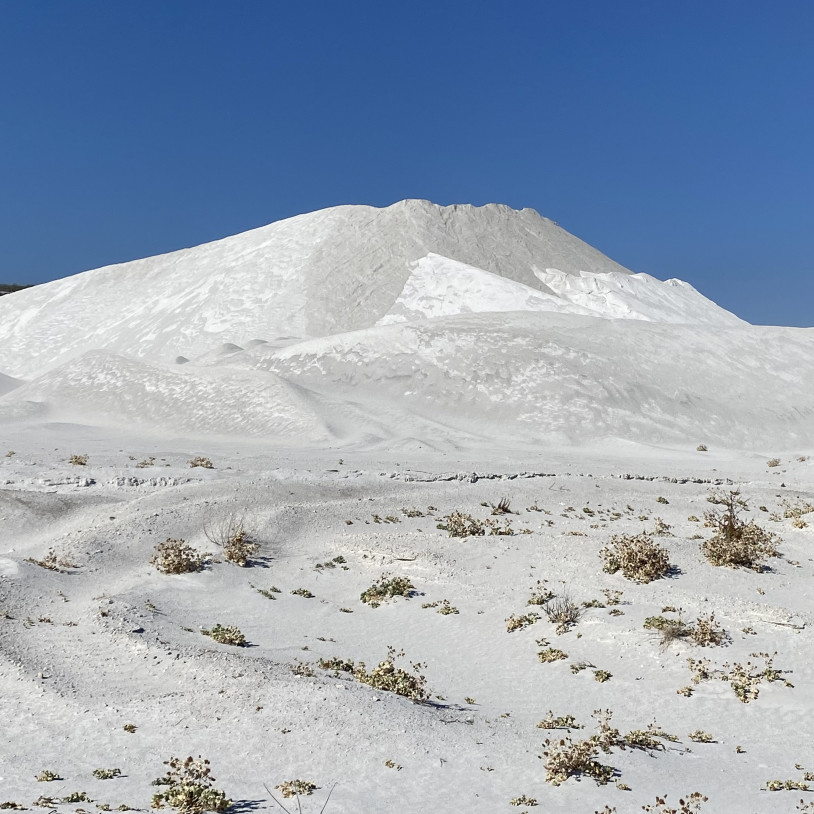
A telescope was installed on Nisyros, trained on Eleni's research station. The windows were often open. Sometimes lights could be seen burning at night, or small movements of objects on the terrace. After a few months, radio communications became less frequent. Eleni responded only when she had new observations to report.
One day, she sent an image of a white sphere, about the size of an apple.
She had found it in the quarry, among fragments left at the edge of an abandoned excavation face. It was perfectly smooth, with none of the visible cavities of ordinary pumice. The instruments, however, indicated an exceptionally high internal porosity. Its surface could not be drilled, although Eleni was able to move the sphere from one part of the laboratory to another without difficulty.
In subsequent photographs, the sphere appeared on a table outside the station. Beside it, Eleni had arranged several other pieces of pumice of different sizes.
The images were accompanied by a few measurements and a question: if a cavity could no longer be reached from the outside, on which side was its interior?
No one could answer her.
Several more weeks passed. One morning, the observers on Nisyros noticed that the sphere was no longer on the table.
The telescope located it shortly afterwards, suspended a few millimetres above the white surface of the quarry.
It cast no discernible shadow. Its position appeared unchanged, yet the measurements showed a slightly different distance from the ground each time.
Eleni offered no explanation.
Over the following weeks, the sphere continued to move away from the surface, so slowly that its movement could not be observed directly. Each photograph showed it in a position just perceptibly different from the last.
Then, comparing the images, the researchers discovered something they had not been looking for.
The distance between the sphere and the ground was increasing, yet neither had changed position relative to the stars.
They repeated the measurements using other reference points: the quarry structures, the sea horizon, the coordinates recorded by the satellites. The results did not agree. Each system returned a different distance.
In the last photograph transmitted from Gyali, the sphere was still suspended above the quarry. Behind it were the island's hills and, farther away, the sea.
On the back of the image, Eleni had written only:
Neither surface needs to move.