


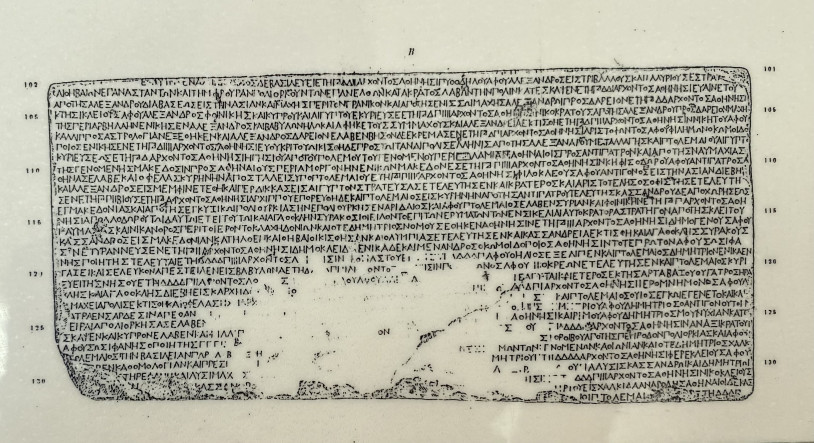
False Relief
Notes from a Coastal Passage
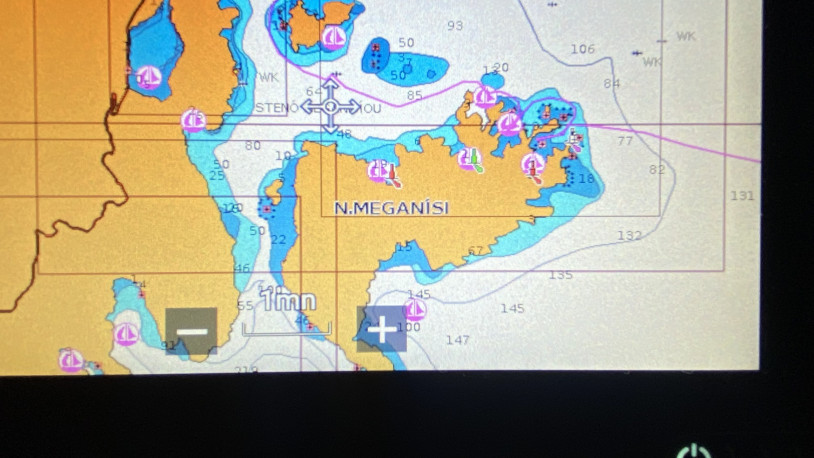
The nautical chart marked out the stretch of coastline, its depths and possible anchorages. The photographs were intended to make it recognisable on a subsequent voyage. The first showed a white rock face, broken by patches of vegetation and a few dark cavities near the waterline. Yet in the next photograph, the same cliff looked different. What had appeared to project from the rock had become a recess, while previously indistinct forms now bore a striking resemblance to carved figures. It was not simply the distance that had changed between one image and the next. What seemed to be there, in front of the boat, had changed too.
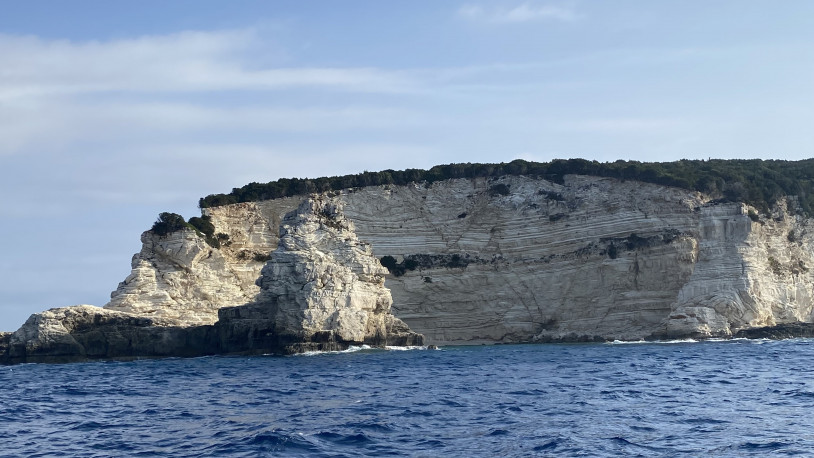
The photographs began to record not so much the coastline itself as the transformations it underwent as the boat moved past. The cliff seemed to contain a succession of bas-reliefs, though none formed a recognisable scene. One body appeared incomplete, one profile overlapped another, a shape seemed to emerge from the stone only to disappear back into its surface. There was no single vantage point from which the entire composition could be seen. As the boat approached, the figures lost their coherence; as it moved away, others appeared. The passage along the coast produced a series of incompatible images of the same place.
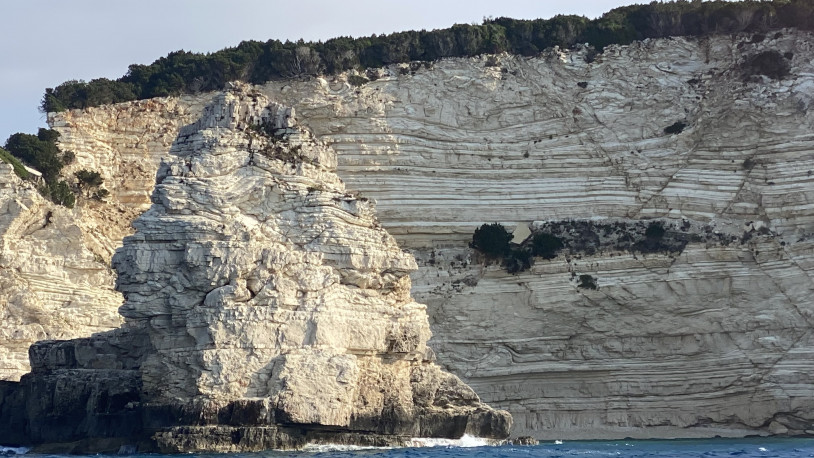
Geology offers another possible reading. Meganisi contains sequences of marine sedimentary rocks in which deformed strata have been documented, including structures produced when sediments slipped downslope before becoming fully consolidated. Such material can bend and fold before turning to stone, preserving traces of its movement within the resulting rock.
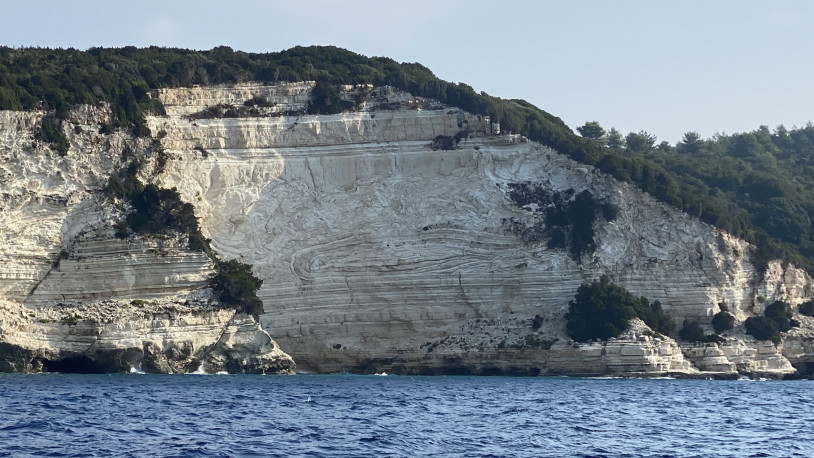
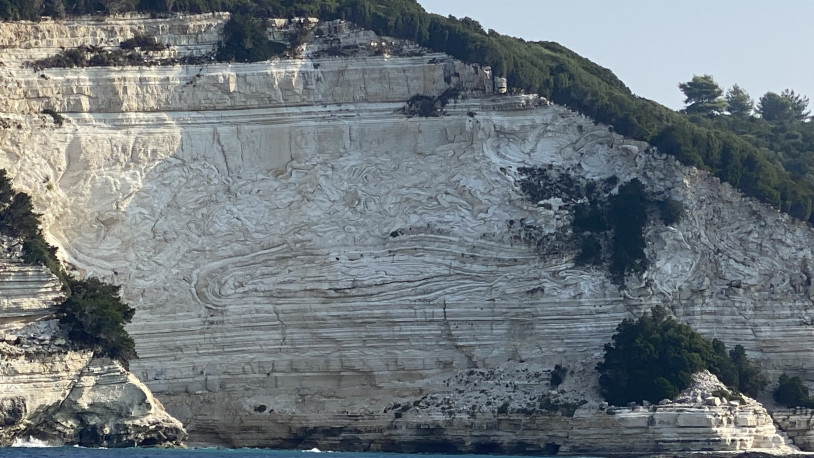
The photographs of the cliff seem to suggest something similar: relatively undisturbed layers alongside others whose arrangement has been profoundly altered. Yet the images alone cannot establish whether these particular deformations are sedimentary, tectonic or the result of several overlapping processes. Identifying the formation and examining the rock in situ would be necessary.
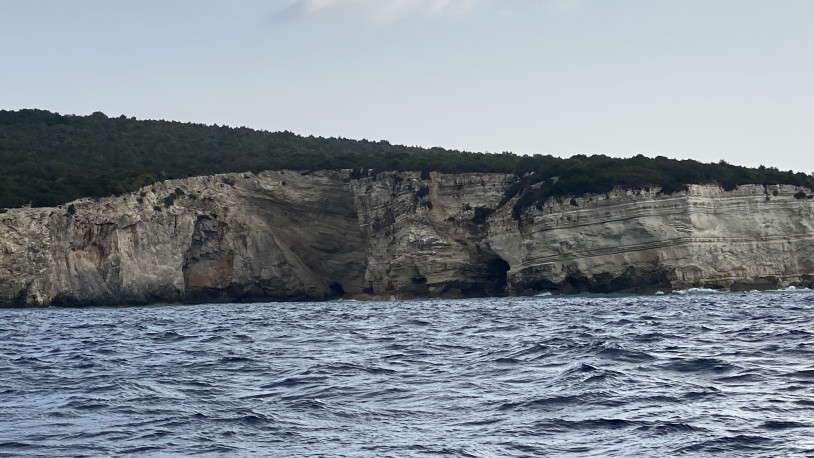
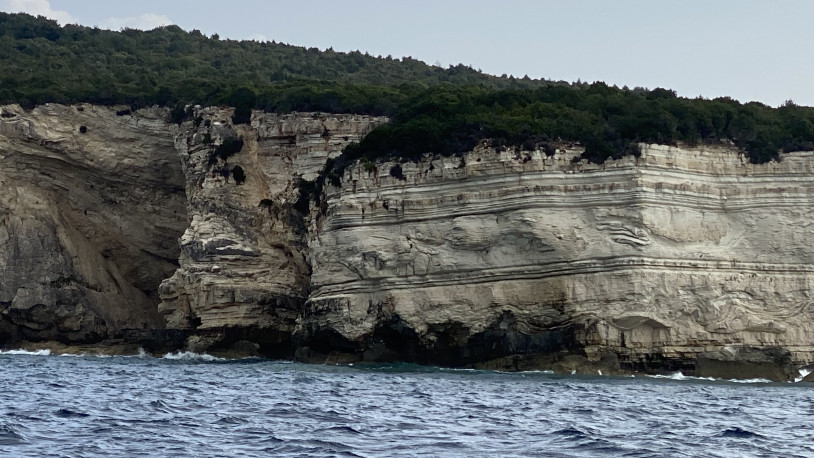
What looked like a bas-relief may never have been carved at all. Its forms may have emerged through processes that took place millions of years before there was a human eye to perceive them. They would represent nothing, yet continue to suggest figures. The surface of the cliff would have its own geological history, independent of anything we might recognise in it, while the sequence of photographs would register a second, far briefer event: the moment a natural formation is mistaken for an intentional image.
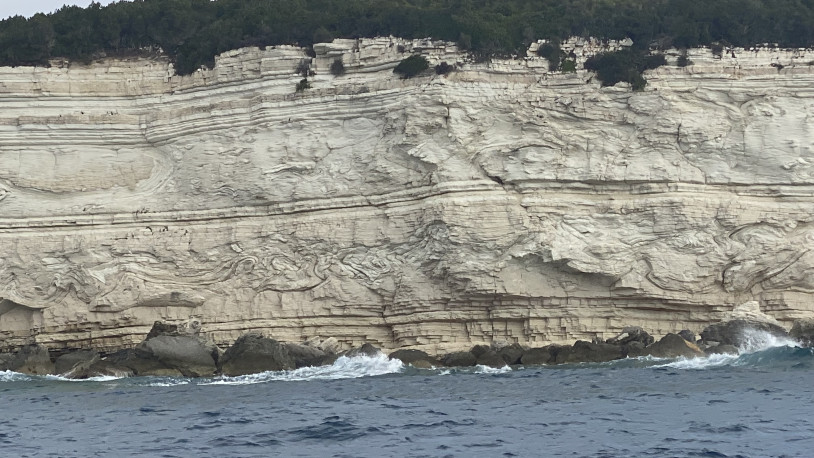
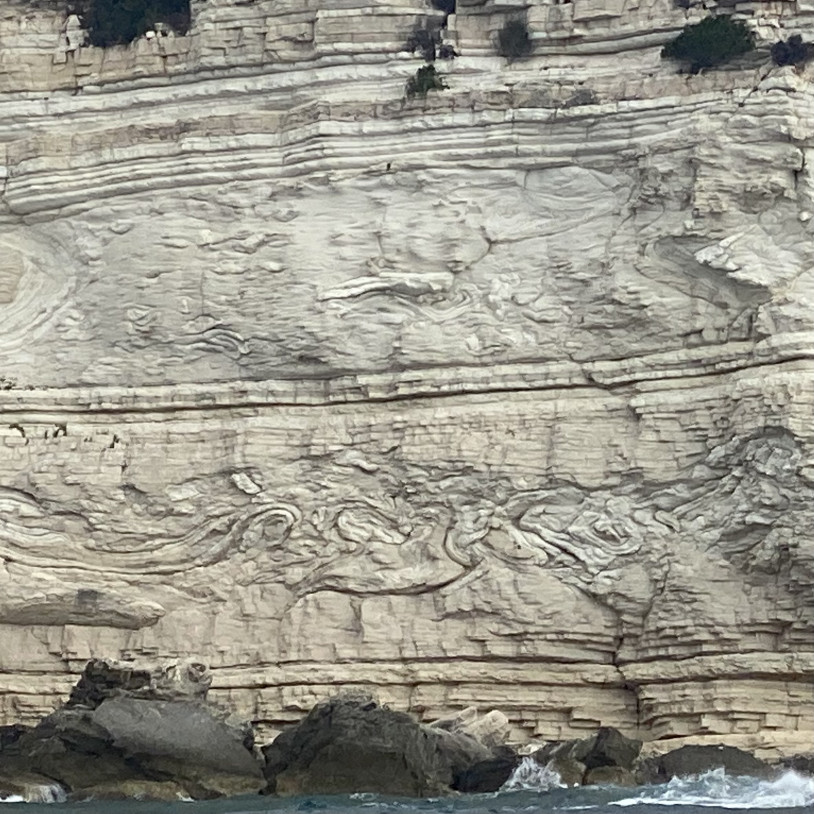
There is a further difficulty. A bas-relief can be examined again by returning to the same wall. Here, that would not be enough. One would also have to recover the boat's position, its distance from the cliff, the observer's height and the angle of the light. The figure belongs as much to the rock as to the point from which it is seen. It cannot be entirely separated from either.
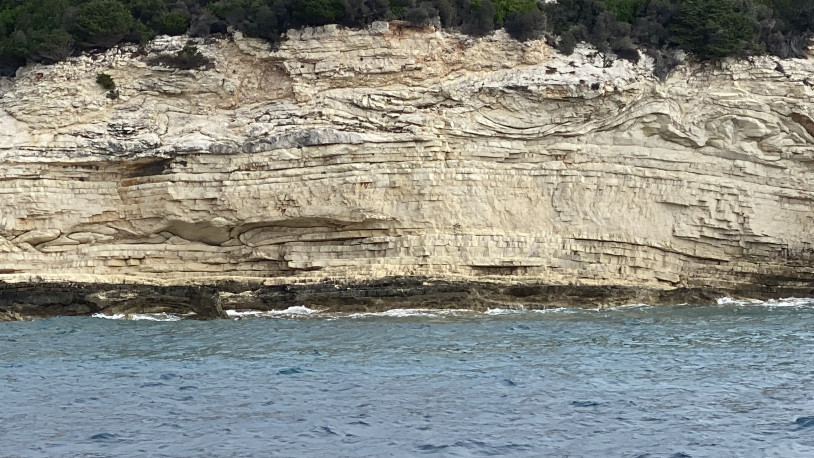
By the end of the passage, the photographs no longer serve merely as geographical documentation. They resemble fragments of a work for which no complete image exists. Some details can be brought together; others refuse to align. One could attempt a reconstruction, but the result would be an object that had never existed.
The passage could be repeated, though there would be no guarantee of finding the same figures again.
Geological source: Magganas et al., Petrology and Provenance of Lithic Raw Materials Used to Knap Stone (2019), particularly Figure 4a, showing deformed limestones of the Vigla Formation. The geological structures visible in the photographs have yet to be identified through direct examination of the site.
Side story — The Golden Hair
Pterelaus, ruler of the island of Taphos, was descended from Poseidon. The sea god had granted him immortality by placing a golden hair on his head. His invulnerability depended not on the strength of his body, but on something that could be taken away.
According to the Bibliotheca attributed to Apollodorus, the sons of Pterelaus laid claim to part of the kingdom of Mycenae, asserting an ancestral right to it. When King Electryon refused, they raided his cattle. In the fighting that followed, almost all the sons on both sides were killed. Amphitryon, charged with avenging them, organised an expedition against the islands of the Taphians, gathering allies including Cephalus, Panopeus, Heleus and Creon. The islands were laid waste, but Taphos held out: as long as Pterelaus remained alive, it could not be taken.
It was his daughter Comaetho who brought that resistance to an end. Having fallen in love with Amphitryon, she removed the golden hair from her father's head. Apollodorus writes, «τὴν χρυσῆν τρίχα τοῦ πατρὸς ἐκ τῆς κεφαλῆς ἐξείλετο», meaning, “She plucked the golden hair from her father's head.” Pterelaus died, Taphos fell, and Amphitryon conquered the islands. But he did not reward Comaetho. He killed her and returned to Thebes with the spoils.
The story continues with another deception. Before Amphitryon returned, Zeus assumed his appearance and visited his wife, Alcmene, prolonging a single night to the length of three. Heracles was born from their union.
Pterelaus's golden hair was never a weapon. It was an almost imperceptible part of his body, yet both his immortality and the survival of his kingdom depended upon it. Comaetho knew the secret and destroyed them both with a single gesture.
Source: Pseudo-Apollodorus, Bibliotheca, II.4.5–8. The traditional identification of Taphos with Meganisi is not universally accepted.
Side story — Iron for Copper
In the opening book of the Odyssey, Athena arrives on Ithaca while Odysseus is still far from home and Telemachus is living in a household overrun by his mother's suitors. The goddess takes the form of Mentes, son of Anchialus and ruler of the Taphians, a seafaring people known in antiquity for trade and maritime raids.
When Telemachus asks who he is and where he has come from, Athena supplies an identity complete with a voyage. She says that she rules the Taphians, whom Homer calls «φιληρέτμοισιν», “lovers of the oar”, and that she has arrived with her ship and crew. She is sailing towards Temese, among people who speak another language. Her cargo is gleaming iron, which she intends to exchange for copper. She even names the place where she has supposedly left her vessel: the harbour of Rheithron, away from the town, beneath the wooded slopes of Mount Neriton.
Every detail is plausible. The cargo, destination, goods to be exchanged and place of anchorage add up to a voyage that might be plotted on a chart. Yet it is Athena who gives this account. The poem describes no trading voyage undertaken by the goddess: the ship exists within the story she has chosen to tell.
Telemachus listens to the visitor, who presents himself as an old friend of the family. Under this assumed identity, Athena speaks to him of his absent father, urges him to seek news of Odysseus and encourages him to confront the suitors. When she leaves, she does not return to the harbour where she claims her ship is moored. Instead, she rises into the air like a bird. Only then does Telemachus realise that his visitor was divine.
In this episode, the first Taphian voyage described in the Odyssey is also a fiction. A goddess invents a journey to make her presence credible and persuade a young man to undertake a real one.
Source: Homer, Odyssey, Book I, lines 170–324, particularly 180–186 and 319–323. The trading voyage is described by Athena while disguised as Mentes.
Note: The documentation includes notes and materials gathered through field research, meetings and conversations with local residents, alongside bibliographic research and further reading, together with photographs taken during the study trip to Greece between mid-September and 7 November 2021.
The materials presented document an ongoing research process and form part of an evolving archive, whose contents will continue to be expanded, developed and revised until the completion of the final artwork, scheduled for autumn 2028.